


Learn how to Market Phases Made Simple: Trade Like a Pro
Introduction: The Secret Behind Market Movements
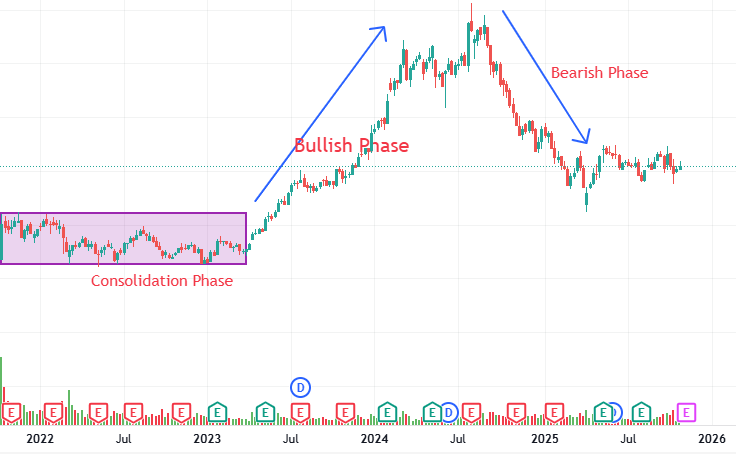
In the stock market, price is never constant — it’s always moving. Sometimes it surges upward, sometimes it crashes, and at other times it just drifts sideways. These movements form what traders call market phases.
Smart investors don’t try to predict the market — they recognize which phase it’s currently in.
Once you can identify whether a stock, index, or sector is bullish, bearish, or sideways, your decisions become clear and confident. In fact, if you can correctly identify the market phase, 90% of your work is already done.
Here’s how to decode these phases and trade like a pro.
1. Bullish Market Phase — The Uptrend Zone
A bullish market phase is the most exciting part of the market cycle. Prices move consistently higher, investor sentiment is positive, and optimism fills the air. You’ll often hear terms like “the market is booming” or “stocks are flying.”
Characteristics of a Bullish Phase (Market Phases Made Simple)
- Charts show higher highs and higher lows
- Strong momentum across leading sectors
- Frequent breakouts above resistance levels
- High trading volumes during rallies
- Positive news flow and strong corporate earnings
- Rising investor confidence and economic optimism
What Should You Do in a Bullish Market? (Market Phases Made Simple)
- Buy the dips: Every correction is an opportunity.
- Hold your winners: Let your profits compound.
- Trail your stop-loss: Protect gains as prices rise.
- Stay patient: Long-term investors are rewarded.
In a bullish trend, the market rewards patience and discipline.
Know about Maruti Suzuki Stock
2. Bearish Market Phase — The Downtrend Zone (Market Phases Made Simple)
The bearish phase is the complete opposite. Prices keep falling, panic spreads, and the market mood turns fearful. Negative news dominates headlines, and investors rush to exit their positions.
Characteristics of a Bearish Phase
- Charts show lower highs and lower lows
- Selling pressure dominates any small rally
- Breakdown from key support levels
- Weak earnings and pessimistic outlooks
- Rising volatility and fear-driven trading
What Should You Do in a Bearish Market?
- Exit long positions: Don’t fight the trend.
- Avoid new buying: Preserve your capital.
- Short-sell (if experienced): Trade the downside carefully.
- Hold cash: Sometimes doing nothing is the best strategy.
In a bearish phase, protecting your capital is more important than chasing profits.
Know the Market Conditions at NSE INDIA
3. Sideways Market Phase — The Consolidation Zone
A sideways or range-bound phase occurs when the market moves within a tight range. Prices oscillate between well-defined support and resistance levels, showing no clear direction.
This is usually a resting phase — the market is gathering strength for the next big move.
Characteristics of a Sideways Phase
- Prices move horizontally between support and resistance
- Low momentum and trading volumes
- Market sentiment is neutral — neither bullish nor bearish
- Frequent false breakouts or whipsaws
What Should You Do in a Sideways Market?
- Avoid long-term positional trades: There’s no clear trend.
- Range trade smartly: Buy near support, sell near resistance.
- Wait for a breakout: The next phase will follow soon.
Sideways phases test patience but prepare you for the next big opportunity.
Bonus Insight: Sectors Don’t Move Together (Market Phases Made Simple)
Here’s a powerful truth most people ignore — not all sectors move in the same direction at the same time.
At any given moment:
- The Banking sector could be bullish
- The IT sector might be sideways
- The Pharma sector could be bearish
This rotation of momentum is known as sector rotation, and it’s the backbone of successful investing.
Money doesn’t just flow into the “market” — it flows into specific sectors that are entering bullish phases.
The Analyst’s Edge: Recognize Sector Phases
A true market analyst doesn’t chase hot tips. They focus on identifying the phase of each sector.
Ask yourself:
Which sector is entering a bullish zone?
Which one is stuck in a sideways range?
Which sector is turning bearish?
Once you identify the phase, everything becomes simpler:
Stock selection improves
Risk reduces
Accuracy increases
Money flows where momentum grows. Recognize the phase, pick the right sector, and you’re already ahead of 90% of traders.
Market Phases at a Glance
| Market Phase | Trend Direction | Investor Emotion | Strategy |
|---|---|---|---|
| Bullish | Uptrend | Optimism, Confidence | Buy & Hold |
| Sideways | Range-bound | Uncertain, Neutral | Wait or Range Trade |
| Bearish | Downtrend | Fear, Panic | Exit or Short |
Final Thoughts: Trade Smart, Not Hard
Understanding market phases is the foundation of professional trading and investing.
Instead of reacting emotionally to every price move, learn to analyze the market’s behavior. Recognizing whether the market (or a sector) is bullish, bearish, or sideways helps you act strategically — not impulsively.
Once you master this, you’ll:
- Stop second-guessing your trades
- Avoid emotional decisions
- Ride trends confidently
- Protect your capital during downturns
The moment you identify the market phase, clarity replaces confusion.
You no longer chase noise — you follow structure.
And that’s how you master the market like a pro.
⚠️ Disclaimer
The information provided in this article is for educational and informational purposes only. It does not constitute financial, investment, or trading advice. Stock market investments are subject to market risks, and past performance is not indicative of future results.
Readers are advised to conduct their own research or consult with a certified financial advisor before making any investment decisions. The author and publisher are not responsible for any financial losses or damages arising from the use of the information provided herein.
- Indian Stock Market Update – 27 March 2026
- Indian Stock Market Update – 25 March 2026
- Indian Stock Market Update – 24 March 2026
- Indian Stock Market Updates- March 24, 2026, the Indian market is set for a massive recovery rally.
- Indian Stock Market Update – 23 March 2026
Open your DMAT Account Now for Investment click the pic below

About the Author — StockBioData
At StockBioData, we believe that knowledge is the real market power. Our mission is to simplify the world of investing, trading, and financial analysis so that every reader — from beginner to pro — can make smarter and more confident decisions.
We’re passionate about helping you understand market trends, sector rotations, and investor psychology — the tools you need to grow steadily in the stock market.
Follow StockBioData for daily insights, educational content, and powerful trading wisdom that helps you stay ahead in every market phase.
Stay informed. Stay disciplined. Trade smart — with StockBioData.



Pingback: How to Pick the Right Stock Like a Pro — Even If You Are a Beginner - Stock Bio Data
Pingback: WIPRO SHARE PRICE & STOCK ANALYSIS - Stock Bio Data