View of Tata Motors stocks (Educational Blog — Not a Buy/Sell Recommendation)
Introduction
In the Indian stock market, only a few companies truly stand out as stories of transformation — and Tata Motors Stock is definitely one of them.
From manufacturing trucks in the 1940s to becoming the leader in India’s electric vehicle (EV) revolution, Tata Motors has evolved into a global automobile powerhouse.
Moreover, whether you are an investor, trader, or automobile enthusiast, Tata Motors deserves a place in your watchlist — not because anyone recommends it, but because its business fundamentals, product innovation, and brand strength speak volumes.
Tata Motors Stock Company Snapshot
| Particular | Details |
|---|---|
| Company | Tata Motors Ltd. |
| Industry | Automobiles (Passenger + Commercial + EV + Luxury) |
| Founded | 1945 |
| Headquarters | Mumbai, India |
| Group | Tata Group (India’s largest conglomerate) |
Transition: Now that we know the company background, let’s look at where its stock stands in the market.
Tata Motors Stock Exchange Information
| Particular | Value |
|---|---|
| NSE Symbol | TATAMOTORS |
| BSE Code | 500570 |
| Index | NIFTY 50, NIFTY Auto, and NIFTY 500 |
Tata Motors CAGR / Returns Overview
| Time Period | Stock Price CAGR / Approximate Return |
|---|---|
| Last 3 years (as on 01/11/2025) | ~18% p.a. |
| Last 5 years (as on 01/11/2025) | ~38% p.a. |
| Last 10 years (as on 01/11/2025) | ~6% p.a. |
Transition: To better understand Tata Motors’ standing, let’s compare it with other major players in the auto industry.
Peer Comparison — Tata Motors vs Competitors
| Company | Segment Focus | Key Strength / Market Position |
|---|---|---|
| Tata Motors Ltd. | Passenger, Commercial & Electric Vehicles | EV leader (70%+ market share), growing PV segment |
| Maruti Suzuki | Passenger Vehicles | India’s largest carmaker; strong in small cars |
| Mahindra & Mahindra | SUV & Utility Vehicles | SUV leader; expanding EV plans |
| Hyundai Motor India | Passenger Vehicles | 2nd largest carmaker; strong mid-segment presence |
| Bajaj Auto | Two- & Three-Wheelers | Market leader in 3-wheelers; strong exports |
| Eicher Motors (Royal Enfield) | Premium Two-Wheelers | Global leader in mid-range premium bikes |
| Ashok Leyland | Commercial Vehicles | Strong in buses & heavy trucks |
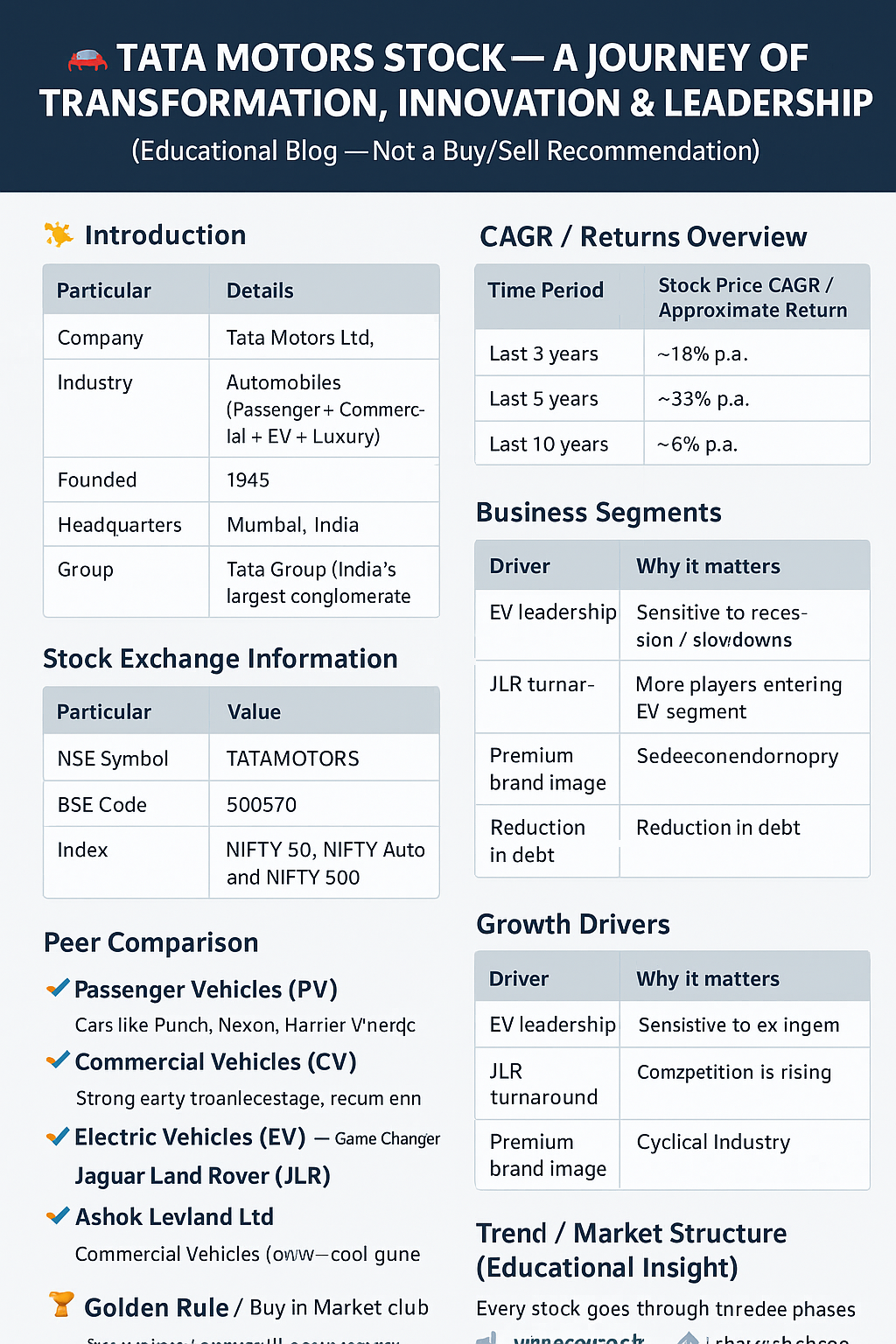
Business Segments
Tata Motors’ revenue comes from four major verticals, making it one of the most diversified auto companies in India.
1. Passenger Vehicles (PV)
Models like Punch, Nexon, Harrier, Safari, Altroz have become household names.
The brand perception has shifted from “value for money” to premium design, safety, and technology.
2. Commercial Vehicles (CV)
Tata Motors is a leader in trucks, buses, and defense vehicles — serving both domestic and global needs.
3. Electric Vehicles (EV) — The Game Changer
Tata Motors is India’s No. 1 EV Manufacturer.
Popular models like Tiago EV, Nexon EV, and Punch EV have made EVs mainstream and affordable.
4. Jaguar Land Rover (JLR)
Tata Motors owns JLR, a global luxury car brand that contributes significantly to revenue and profitability.
Transition: After exploring the business structure, it’s essential to understand what drives Tata Motors’ growth story.
Growth Drivers
| Driver | Why It Matters |
|---|---|
| EV Leadership | Early entry → high market share → customer trust |
| JLR Turnaround | Improving global margins and brand image |
| Premium Brand Positioning | Focus on safety, design, and new-age technology |
| Debt Reduction | Company aims to become net-debt-free, improving financial health |
Transition: However, even strong companies face challenges. Let’s review the risks you should know.
⚠️ Risk Factors
| Risks | Impact |
|---|---|
| JLR depends on global demand | Vulnerable to global slowdowns or recession |
| EV Competition Rising | New players (like BYD, MG, Hyundai) increasing competition |
| Cyclical Industry | Auto demand depends on GDP, fuel prices, and interest rates |
Stock Trend & Market Structure (Educational Insight)
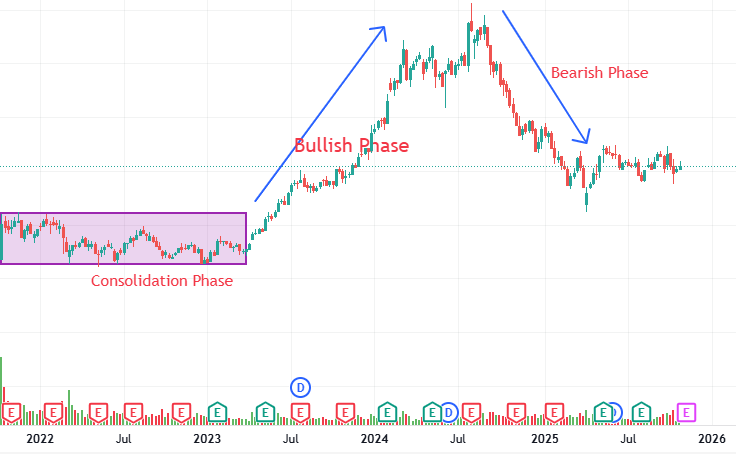
Every stock goes through three key phases:
Sideways Phase — Accumulation or distribution
Bullish Phase — Higher highs with strong momentum
Bearish Phase — Lower highs and declining demand
Lesson:
👉 Don’t buy a stock just because the company is good.
👉 Buy it when the trend supports your decision.
Your goal as an investor or trader is not just to select great businesses —
but to enter them at the right market phase.
⭐ Golden Rule
“Buy in Bullish Phase — Avoid Sideways & Bearish Phase.”
Our research and content focus on price action, trend structure, and volume analysis — helping you identify the current phase of a stock.
From there, you can add it to your watchlist and discuss it with your financial advisor before investing.
📌 Disclaimer
This blog is purely for educational purposes.
We do not provide buy/sell/hold recommendations.
Always consult a SEBI-registered financial advisor before making investment decisions.
- WIPRO SHARE PRICE & STOCK ANALYSIS
- STATE BANK OF INDIA (SBI) STOCK ANALYSIS
- INFOSYS STOCK ANALYSIS
- JSW Steel Ltd. — Forging India’s Growth in Steel & Sustainability
- How to Pick the Right Stock Like a Pro — Even If You Are a Beginner
Open your DMAT Account Now for Investment click the pic below